Thursday, 16 April 2015

Where Are All the Women?

Recently I traveled to Argentina, and, as I can't help but do now, tried to get a sense of the culture of two-wheelers in another country. Two-wheels versus cars, motorcycles versus scooters, city versus country, female riders versus male riders...that sort of thing.

It's never a scientific survey, more of an impression, one made this time while sitting in the parks and cafes in Buenos Aires and being out on the road in other parts of the country. There were plenty of two-wheeled vehicles - why not in a country with a climate that allows for a long riding season? And there seemed to be a mix of scooters and motorcycles on city streets that was difficult to quantify.

What did strike me was the wide spread between the number of female riders and the number of men.

This is a country with a female president, although one under constant assault for wrongdoing, mind you. This is the country that turned Eve Peron into dear Evita, a saint to many with her own fawning museum. This is a country with women who look comfortable in their own skin visible in the workforce and on the streets.

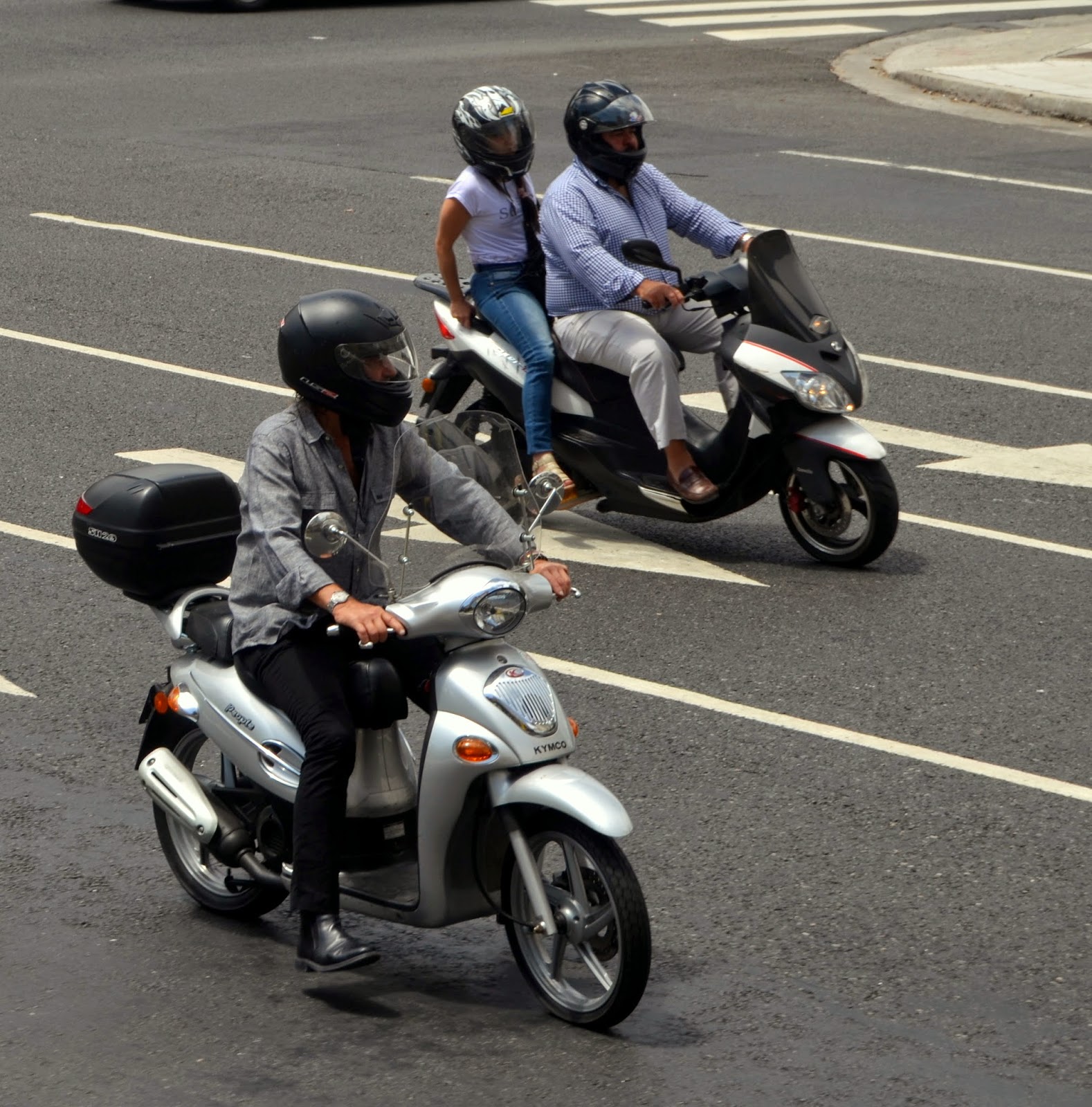
I did see one woman on a mod-looking scooter with a flowing skirt and others on motorcycles and more practical-looking scooters. But I'd say nine times out of time the riders who whizzed by me were male, sometimes with a woman sitting behind them.


It was a surprise to me. In Vietnam, North America, throughout Europe and even in India, from my experience, the spread is much closer. And I could only conclude that the famous Latin American machismo is alive and well in Argentina when it comes to traditionally male activities like riding two-wheeled vehicles.


Wednesday, 1 April 2015

Electric Prospects in the UK

I'm still thinking a lot about electric scooters...as one reader pointed out to me the problems are not limited to battery charging and battery time...but to top speed as well. Manufacturers, especially in Asia, are quite capable of making electric scooters go fast, but in the west there are often legal limits to how fast they can go. More on that later but for today, I'm just including this link to a story about how incentives for going electric could be extended to scooters in the UK which in return could affect how electric scooters are produced and make manufacturers take them more seriously there.

Saturday, 14 March 2015

Electric future

The snow is starting to melt here in Ontario. It will soon be time to bring my scooter out of the shed. I'm also looking forward to the e-scooter rental place opening near my home so I can do that trial run. While I've always thought my next scooter would be a Piaggio gas scooter, I realize that an electric scooter is a more responsible choice. Despite their success in China where they are mandatory in cities, electric scooters are still a hard sell. In Taiwan, for example, where gas scooters and motorcycles are still cheap ways to get around, they haven't taken off.

We all know that we have to wean ourselves from fossil fuels and if we can find clean sources for electricity, we should rely more and more on the cleaner electric vehicles with their low emissions.

What's the problem then? The answer: batteries, batteries, batteries. And how to charge them. As long as it remains inconvenient to charge electric two-wheelers they'll be a hard sell. So far, Taiwan lacks the infrastructure for charging bikes. As does much of Europe and North America.

Innovators are working on the problem. Some are working on making batteries more efficient.

But this winter a Taiwanese start-up company, Gogoro, announced the development of  its Smartscooter, which is receiving positive reviews. The innovation here: battery swapping. Gogoro envisions battery swap points set up at stations throughout cities, claiming it would take seconds to swap a depleted battery for a fresh one or charge one.

Photo: Gogoro

It all may be a way's off but there's an inevitability to the switch to electric if the charging problems can be fixed. Electric scooter are predicted to do well in the future, and not too far into the future, especially in booming markets like India.

Saturday, 31 January 2015

Scooters and Stereotyping


When I visited the Piaggio factory in Pontadera, Italy a while back I really bought into the story of how the Vespa brought mobility to Italian women in the '40s. But company advertising over the decades suggest a more subtle, mixed message.

This early poster in the Piaggio museum was a glorious start:


Female employees I met at Piaggio are proud of that poster. It symbolizes women waving goodbye to the past after the Second World War when they won the national right to vote. And the Vespa and the Piaggio factory did do a lot to promote women and mobility at the time.

In the Piaggio archives there's this photo of  factory employees in the '40s. Enrico Piaggio, building up the firm's reputation and infrastructure after its destruction in the war, promoted hiring women. Trying to get away from the military history that nearly brought the company down, he's known for saying he wanted to build a vehicle that even "women and priests could ride."


There are no posters from that period of priests on Vespas but there are a lot with women. They don't always stress the triumphant breaking from history the first poster suggests. There are a few that do:


But many of the posters in the museum from the late '40s and the '50s are just redos of the classic sexy woman selling a vehicle.


And when the ads of that time show women and men on scooters it is the man riding with the woman on the back.


Flash forward to this decade and sexy women are still selling Vespas. Take the Vespa 946, an homage to the prototype of 1946 and clearly to the mixed message.

                                                                                                           Vespa


In a French commercial for the 946, a woman in red heels gets on her scooter to ride through the streets in Paris with a flashback to old commercials where men are riding the original Vespas with adoring women behind them. Is the attractive woman dreaming of a time when men rode women around? Is that the message?

I know this has more to do with the world of advertising than the freedom scooters provide so I don't want to make too much of it. But advertising does reflect society. And Vespa is a model for not just scooter manufacturers around the world but for the message as well. A quick search online for images shows that the message of equating sexy with scooters is repeated over and over in Asia.


Take the commercial from India where a sexy female rider of a Scooty pouts and stamps her red high heels to convince a policeman to let her through a police line. Or another one in which a woman on a pink scooter smears lipstick on her lips at a stoplight to tease the male driver beside her. This in a country where women fear gang rapes on the streets!

I suppose in writing a blog with the words 'Scooter Girl' in it, I am buying, to a certain degree, into this notion. I named it that (as I first wrote when I started this blog) after a retro tin doll I have with that name.


That's the image I love, along with that first Vespa poster. I could change the title of this blog to Scooter Woman but I'm not sure that would make a difference. So I'll aim to recommit to finding stories of how scooters and mobility have been positive for women.

Tuesday, 20 January 2015

Mobility and Danger in India

I've written before about the growing market for scooters in India, particularly with young middle-class women. In the past, I've posted Indian ads showing bright, carefree young women on pastel-coloured scooters riding freely through city streets with nothing but admiring looks from young men. And manufacturers have continued to compete for that market with sleek designs, lots of storage under the seats and colours like "candy-blazing red," "dream orange" and "plush pink," all in the name of "female empowerment."

And there's this advice to those marketing scooters to women in a business paper:

Two-wheelers of this kind actually empower women: they can be the riders with power to decide where to go, when to go and whom to go with. I do believe this is a great psychographic opportunity. It is just about being used.
The scooter is a symbol of mobility, power in the hand of a woman. Now, women do not need to depend on anyone to take care of their mobility needs.
In addition to this, I do believe that most scooters thus far, have been either male or neutered in their gender. The scooter that has a neuter gender is not good for men, neither is it good for a woman. Women in particular have been forced to pick such scooters. There is therefore a definite need for manufacturers and marketers to design and position the scooter as a device that is essentially feminine. This can be a huge USP. While physically, many are looking progressively very close to men in terms of attitude, dressing pattern, language and behaviour, at the same time, women are progressively wanting the soft cues of femininity in everything. In everything they eat, drink, drive and ride equally. 
But all those wonderful colours, all those ads and all that talk of empowerment seem at odds with the reality for women on the streets of India where gang rapes and other violence happen all too often. Scooters are sometimes seen as a safer option for women than public transportation but that hasn't been a major part of the pitch.

Now, one product acknowledges the contradiction of the joy of mobility and the dangers for women of getting around. A joint Japanese-Indian venture has introduced Nirbhaya, a low-speed electric scooter that will be sold at a small discount to women. Safety is the message: the scooter is equipped with a GPS; a woman can press an SOS button on it that immediately lets family members know where she is. There's nothing subtle about the vehicle's name: Nirbhaya, meaning fearless, was the name given to the victim of the gang rape in Delhi in 2012 to protect her identity. It's also the name of a fund set up by the government for the safety of girls and women.


Photo from IndiaToday,in

It's marketing, of course, but hopefully marketing that shows India is taking the safe mobility of women seriously.

Saturday, 17 January 2015

What Should My Next Helmet Be?


I've been going on about helmets lately and I think that’s because I know I need to buy a new one this spring. It’s a Canadian tradition to mull over decisions for summer on cold winter nights. My father always picked the seeds for his garden in January and February. So deciding on a helmet and imagining riding with it in warmer months seems appropriate.

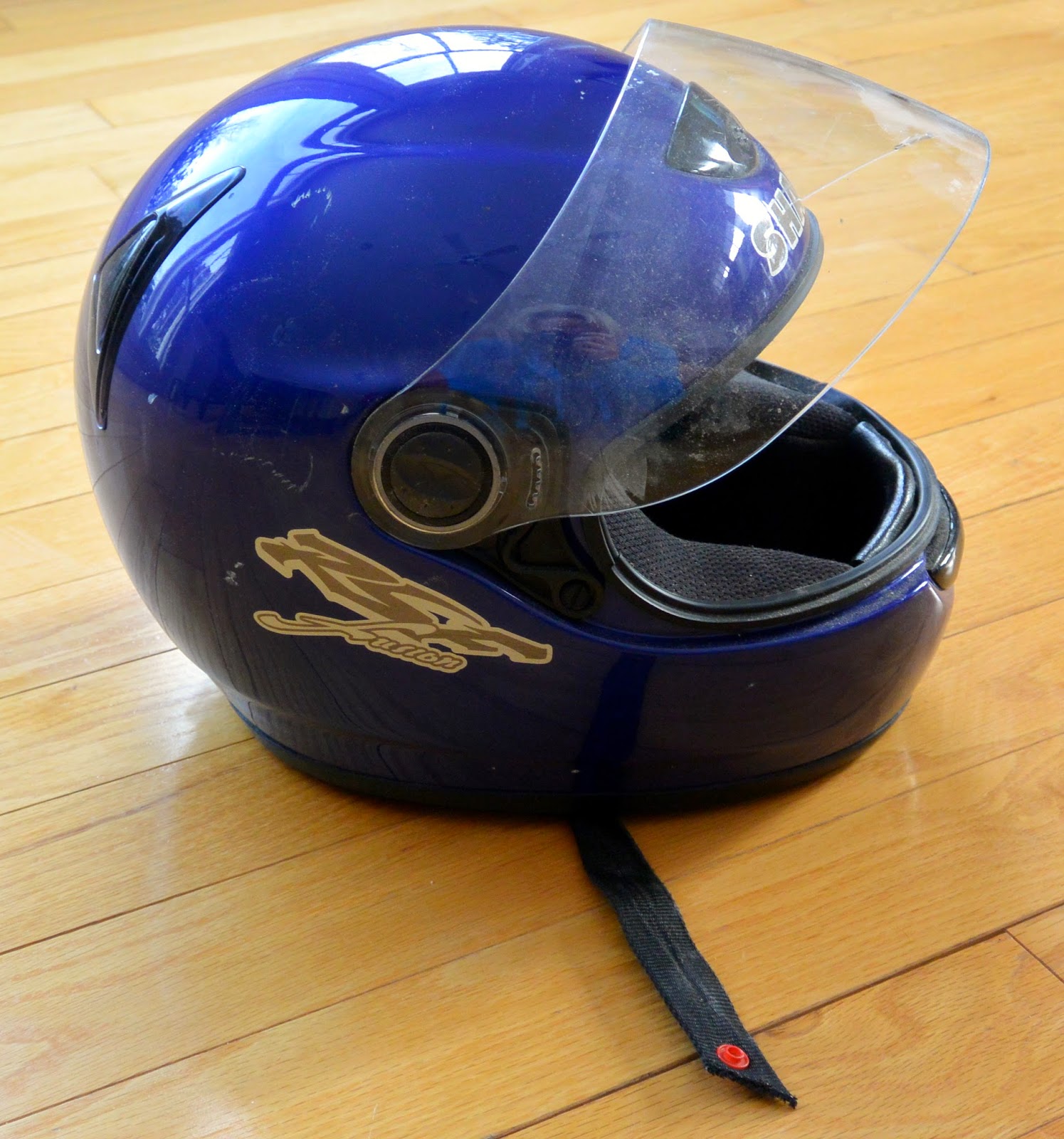
My old helmet still looks okay.


And because it doesn't appear to be defective, I've been slow in replacing it. When I took a motorcycle training course more than ten years ago, the instructor said helmets should be replaced every seven years even if they hadn't been dropped because the foam inside them disintegrates. I bought my helmet about the same time as that course and I have to admit it’s had a few falls around the house. In online discussions there's still a perception that helmets are good until the first accident, but a site called Motorcycle Basics, says helmets only have a lifespan of five years. Most manufacturers use that figure too although some sites suggest that newer model helmets, if cared for, can last longer.

I don’t need to be convinced that it’s essential to have a good helmet:

“Our role is to identify ways to prevent injury and death
and rigorously check what works and what does not work.
For motorcycle safety, the research shows that universal
helmet laws are the most effective way to reduce the
number of deaths and traumatic brain injuries that
result from crashes.” Dr. Thomas Frieden, Directer CDC.

That's from a report by the Centers for Disease Control and Prevention on motorcycle safety, The report goes on to say that helmets reduce the risk of death by 37 per cent and head injuries by 69 per cent and that universal helmet laws are much more effective than partial helmet laws which only require certain groups to wear helmets. They site Florida as an example of why partial laws don't work. The state repealed its universal law in 2000, changing to a law that said only those under 21 years old or those with less than $10,00 had to wear helmets. In the thirty months after the law changed, compared to the 30 months before, deaths of all riders increased by 55 per cent. Even those under 21 died more often - a startling increase of 188 per cent - I'm guessing because they thought they could get away without wearing helmets.

The sports world is slowly coming to terms with just how much damage brain injuries can do as players age. Trying to avoid severe trauma to the head just makes sense. And just in case you don't believe me, read the long and scary list of the effects of brain trauma from the Mayo Clinic.

So, yes, I want an effective helmet. I’m just confused about what kind of helmet I should buy for the type of scooter riding I do.

The full helmet is still considered safest for any scooter riders who commute on their vehicle...so it’s a good idea for city riders. I have a full helmet because I started out on a motorcycle and just kept it when I switched to a scooter. I don’t ride in a big city anymore so I’m not sure I need that full protection anymore. However, I do ride on secondary highways where speeds are greater than on city streets so maybe I do. Arg! Good thing there are still lots of winter nights to make a decision.

Tuesday, 13 January 2015

Helmets and Religion


In the array of problems with getting people to wear helmets, even religion can be a sticking point. In India, helmets were optional for women in the past because of complaints from the Sikh community that women could not wear anything on their heads but scarves or turban. Sixty-three women died in motorcycle accidents in Delhi last year according to a blog published on the Wall Street Journal India site. The blog reports that although men make up the majority of riders a disproportionate number of women die or suffer head injuries. So the rules changed; women without helmets will be fined unless they are Sikh. It's now up to women to prove they are Sikh when they are stopped by the police.


In this year's road safety week in India (January 11- 17) transport officials have made mandatory helmets part of their platform,


Regional Transport Officer Bhadru Nayak speaking to press                                Picture from Hans India

And, as part of a month-long campaign to make riders and car drivers more conscious of safety, police gave more than 200 helmets away on January 3 to two-wheel riders who didn't have one in an event called Joy of Giving. Riders obeying the law got pens and flowers. Officials are certainly trying to get helmets on as many heads as they can.